Management of IT Solution via Good Governance Standards
“The very word "secrecy" is repugnant in a free and open society; and we are as a people inherently and historically opposed to secret societies, to secret oaths and to secret proceedings...Our way of life is under attack. Those who make themselves our enemy are advancing around the globe...no war ever posed a greater threat to our security. If you are awaiting a finding of "clear and present danger," then I can only say that the danger has never been more clear and its presence has never been more imminent...For we are opposed around the world by a monolithic and ruthless conspiracy that relies primarily on covert means for expanding its sphere of influence–on infiltration instead of invasion, on subversion instead of elections, on intimidation instead of free choice, on guerrillas by night instead of armies by day. It is a system which has conscripted vast human and material resources into the building of a tightly knit, highly efficient machine that combines military, diplomatic, intelligence, economic, scientific and political operations. Its preparations are concealed, not published. Its mistakes are buried, not headlined. Its dissenters are silenced, not praised. No expenditure is questioned, no rumor is printed, no secret is revealed.”
― President John F. Kennedy
JoHari Window for Organizational Transparency
Under Good Governance, increasing the realm of transparency in the IT Solution Delivery, except for the private keys of each participants, is the aspirational objective toward transparency for the flourishing of mankind.
What is a Johari window? What is a “Realm of Transparency”? Why is the “private key” the only things that needs to be kept secure, private and secret?
JoHari Window (applied to individual)
JoHari Window is concept developed by the authors, “Joe” and “Harry”. It was designed for individuals to gain insight to their own soul, in order to make informed decisions affecting their individual lives. It highlights the needs for others in our lives, to provide greater insights.
Original JoHari windows starts with an individual. It starts with the things that the individual knows and does not know. Categorically, this creates two knowledge realms of the “known areas” and “unknown areas” of one’s life. Things the individual knows and is aware, falls into the known area realm of the individual’s life. Things the individual does not know and-or unaware, falls into the unknown areas of the individual’s life.
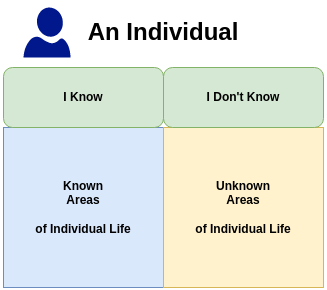
How does one decrease the unknown areas of one’s life? Authors recognizes the need for ‘others’ involvement in providing greater insights to the individual. Intersections of what “I” and “You”, generates 4 areas of possibilities.
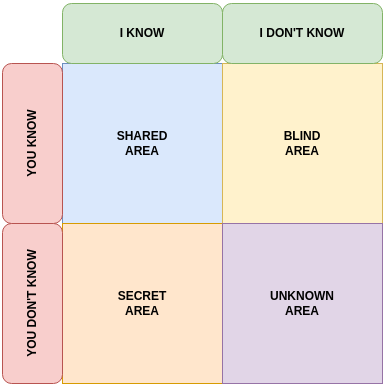
- Intersection of what “I Know” and what “You Know”, is the [ SHARED AREA ] of the individual’s life.
- Intersection of what “I Know” and what “You Don’t Know”, is the [ SECRET AREA ] of the individual’s life.
- Intersection of what “I Don’t Know” and what “You Know”, is the [ BLIND AREA ] of the individual’s life.
- Intersection of what “I Don’t Know” and what “You Don’t Know”, is the [ UNKNOWN AREA ] of the individual’s life.
JoHari Window (applied to Institutions)
When this JoHari concept is applied to institutions, we get the following states of 4 realms of organizational knowledge.
Assumed High Level Current State of Transparency
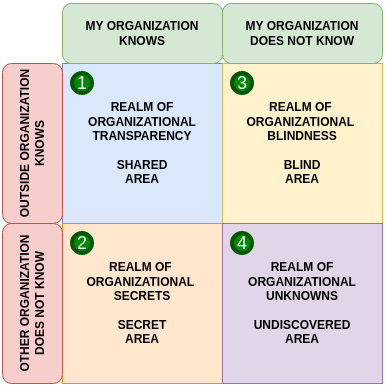
- Realm of Organizational Transparency
- Realm of Organizational Secrets
- Realm of Organizational Blindness
- Realm of Organizational Unknowns
Nature of IT Solutions is the hierarchical upstream dependence of logical knowledge domain realms. The knowledge realm of L1: “IT solutions delivery as a service” is depends on L2: IT Solutions, which is dependent on L3: computer science, which is dependent on L4: engineering, which is dependent on the L5: physics, which is dependent on L6: mathematics, which is dependent on and is branch of L7: logic.
All to say that the knowledge domain realm of “IT solutions delivery as a service” represents the highest order of an enterprise systems of systems compounded complexities.
Pragmatically, this means that no one organization consuming and providing IT solution services, possesses all the subject matter expertise knowledge to oversee well the IT solutions on behalf of the organizations and mission.
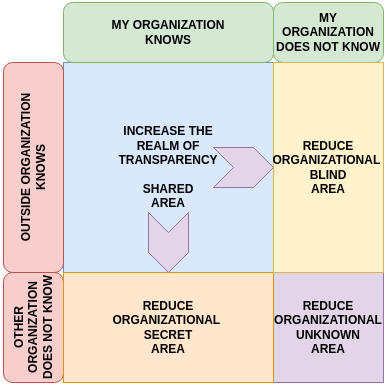
Hence, in order for an organization to oversee the IT Solutions consumed and provided well, the need for continuous collaboration to increase the realm of transparency, the shared area, ultimately leading to reduction of organizational blindness, organizational secrets and gradually minimizing the organizational unknown areas.
Practically, for IT solutions, the greater the unknown areas represents greater risks in security.
| Assumed High Level Current State of Transparency | Desired High Level Progression to Increase Transparency |
|---|---|
|
 |
Therefore, good governance of IT solutions is synonymous with transparency in oversight of IT solutions.
This leads to asking the question, “What are the elements of constrained things that should be transparent in overseeing IT Solution Delivery as a Service?”
Seven Elements of Transparent Mission Fulfillment
Secrecy = Poor Governance

Transparency = Good Governance
Those that seek to accomplish objectives of governance via secrecy or governance by transparency, are constrained by the same 7 elements to bring about success of their respective higher mission objective.
Under good governance of IT Solutions, the following 7 elements of transparent mission fulfillment are considered during the planning and execution.
- Purpose
- People
- Patterns
- Processes
- Processors
- Power
- Politics
1. Purpose
Transparent good governance of “Purpose(s)”, as a concept deals with the final cause, for which the mission will be fulfilled.
In order to accomplish any mission, clarity of purpose is required. Hence, questions like, “What is the target objective?” “Is it achievable?” “Is the purpose clearly defined and known by all parties?”, “What is the success criteria?”, more questions like these, constrains and creates the boundaries and directions for all downstream actions. Even for software developers, question related to purpose in asking, what functional purpose objective am I going to accomplish with this code? If the code is too large and complex, asking what sub-objective codes can be decomposed and solveed via multiple discrete smaller sub routine break down structures?
These types of questions address and deals with providing the motivation, in answering the "why" and aligning all downstream activities of layered breakdown structures of sub-objectives, is the concept of the layered final cause.
When applied to HCI / Azure Stack, the purpose of the Azure Stack to PEO DCE, it is to provide the hardware, hypervisor and management software for the IaaS implementation at various Navy locations.
There can be many success criteria for each network providing essential enterprise network function, but in the cloud native paradigm, the metric that matters is that IaaS management network must be accessible from anywhere around the world to increase transparency.
2. People
Transparent good governance of “People”, as a concept deals with the efficient cause, by which the mission will be fulfilled.
Institutions have roles, and roles are filled by individuals, i.e. people. Hence success of the mission depends on people. Strategists, architects, engineers, field operators, logistics are various institutional roles in the service delivery pipeline which are filled by people.
Under good governance of IT Solutions, many operational roles must be filled by individual people. Prior to hiring of people, roles or traditionally job descriptions must be filled, aligned to the hard technical skills and knowledge required to fulfill the roles.
For Navy, scope taxonomy of IT Solution delivery roles are required to be able to find the people with the right skills and knowledge to fill those roles. In a cloud native paradigm, roles needed to delivery IaaS, PaaS and SaaS, particularly, those that can fill with roles with in complexities of the IaaS provider, PaaS providers and SaaS providers.
3. Patterns
Transparent good governance of “Patterns” as a concept deals with exemplar cause, after which the mission will be fulfilled.
Knowing the scope of things important to accomplish the mission, along with the architectural blueprints, plans and patterns which show the relationship between scope of things is a critical element in providing good oversight.
Under good governance of IT Solutions, service delivery are higher level logically constraints. NIST cloud service models, categorized by IaaS, PaaS, and SaaS, is the defacto standard, constraining each services.
For Navy, decomposed patterns in delivering the services of IaaS are required. See Technical design on IaaS.
4. Processes
Transparency in good governance of “Process(es)” as a concept deals with the formal cause structures of which the mission will be fulfilled.
Once one understands the list of things important to accomplish the mission and relationships between them, the sequencing of item onto an execution plan into times, space / location, by roles, and people must the planned and executed. The process related project plans, provide the sequenced structure for the organization during implementation.
Under good governance, chronologically, what, when, where, who, in that sequence is iterated for each elements of the IT Solution until an executable plan is formulated for execution.
For Navy, solution architect-engineers with the material knowledge, skills, intelligence and craftsmanship, with a mastery of the IT solution to be implemented is required to deploy, sustain and optimize the IT solution to continuously delivery them as a service.
5. Processors
Transparency in good governance of “Processors” as a concept deals with the instrumental cause, through which the mission will be fulfilled.
Each process of the implementation, and sustainment requires tools for people to communicate, share, automate, document and create the proof of work performed. In the age of information, computer is the defacto enabler to the objectives. Hence “Processor” is a representative term to encompass forms of computing which could include cpu & gpu processor hardware and software and applications.
Under good governance, IT Solution is the primary interfacing intermediary tools which will enable the horizontal and vertical objective to be achieved.
For Navy, IT Solutions delivered and consumed as IaaS, PaaS and SaaS, are the processors which will allow Navy to accomplish their subordinate aligned vertical upstream objectives.
6. Power
Transparency of good governance of “Power” as a concept deals with the material cause, out of which the mission will be fulfilled.
Knowledge is power. General knowledge, specialized knowledge, institutional knowledge are all critically needed to create immediate useful value from the successfully implemented IT Solution for the organization.
Under good governance, power is the knowledge required for the execution of delegated constrained authority into creation space for a duration of time. Hence the execution and application of some knowledge of IT Solution for an institutions manifesting into consumable solution is the work of the IT Solutions Providers.
For Navy, the work of the overseers of the IT Solutions is to provide a clear and concise constraints for delegated authorities, which are written and communicated.
7. Politics
Transparency in good governance of “Politics” as a concept deals with the connected cause, amid which the mission will be fulfilled.
In general, politics are the factors taken into consideration in the oversight of the the city, i.e. polis. Under good governance of IT Solutions, politics are external constraints which apply pressures during the pursuit to accomplish the mission. This is the concept of the connected cause, where pressures are considered in the accomplishment of the mission. Seven standards have been identified which drive the good governance of IT Solutions toward continuously measured delivery of services.
| ID | Elements of Mission Fulfillment | Characteristics | Aligned Standards |
|---|---|---|---|
| 1 | Purpose | Achievable | Achievability |
| 2 | People | Accountable | Accountability |
| 3 | Patterns | Validatable | Validatability |
| 4 | Processes | Traceable | Traceability |
| 5 | Processors | Visable | Visability |
| 6 | Power | Consumable | Consumability |
| 7 | Politics | Adaptable | Adaptability |
Seven Standards Toward Transparent Continuous Measure
End to end transparency is the aspiration to combat poor governance.
The wisdom of "be careful what you measure" stems from the idea that what you choose to measure can influence behavior and ultimately, your outcomes. [ This is consistent with the lessons from quantum mechanics and the measurement problem, where the problem is the definite outcome. This is highlighted to note that IT Solutions and Delivery as a Service is indeed constrained by the all the logical knowledge domains that preceded it. Therefore, understanding the pressures of preceded knowledge domains, helps to properly design IT Solutions for the end user with constraints in mind. Hitherto, as more and more constraining “laws” of nature and knowledge domains are discovered, downstream improvement to IT Solutions delivery can be adjusted. ] Hence, below are generalized standard guides, which must be carefully customized and tailored for each IT Solution being implemented for specific institution and the roles which can be supported.
1. Achievablility
To accomplish the mission objective(s), the clarity of purpose(s) is/are required. Hence, the IT Solution to be implemented must be achievable, or must have the ability to be brought about or accomplished successfully.
to The promise of IT Solution to solve a specific problemIT Solution being integration
Why: Information technology is an enabler to a greater mission objective. It is an intermediary instrument through which to the greater mission objective can be accomplished, better, faster and cheaper. Particularly, in this Age of Information, post circa 12.09.1968, nothing of any significance can be accomplished without Information Technology.
Problem: Those that are not functional operators of technology, do not understand the limits of the existing solution and may desire capabilities that does not, can desire IT Solution, that does not exist.
Solution: Only builder-operators and provide insights to the consultants Hence, looking from the perspective of IT as the instrumental enabler, the desired IT Solution objective must be achievable. IT Solution can not be delivered as a solution, if an IT Solution does not exist. IT Solution can not be created without existing IT components which make the IT Solution.
Greater clarity in the discovery and identification of achievable objectives can be used as measures for iterative improvements.
2. Accountabilty
As individual people fill roles within the IT Solution Service Delivery chain, each functional role is responsible to deliver their portion of value within the service delivery chain. Continuous optimization looks for the most efficient path in delivering the IT Solution service. Assumption is that each processes own by a functional roles is a critical link within the service delivery chain. Hence accountability, at the most rudimentary level of metric is the yes or no to the functional service satisfied.
Accountability is a spectrum pendulum: On one side, accountability can show the irrelevance of a process and function within the service delivery pipeline. On the other-side, accountability can show the vast brilliance of a person, fulfilling the functional role. This is usually the common within startup and level 1 organizationally mature institutions.
Greater clarity in the discovery and identification of functional roles in the service delivered can be used as measures of iterative improvements.
3. Validatability
Every design pattern outputs are represented as some form of a blue print plan artifacts. Under good governance, designed blue prints are controlled and shared, making them available to downstream stakeholders for execution to bring the concepts into real world reality.
Availablity of the blue prints as well as configuration documents pertaining to the IT Solutions is one critical metric of validatability. When one performs the function of validation, they are working off of the shared document. Shared blueprint documents provides the force of strength, like a wall or val, root morpheme of the word validation, to the feasibility soundness of the implementation. When the blueprint plans are reviewed by experts and their analysis is shared, this provides the openness, transparency and security to the rest of the stakeholders and downstream participants.
4. Traceability
Implementation and maintenance of an IT Solution, require execution of designs, plans in processes sequenced and orchestrated to ensure the IT Solution meets the mission objective. The concept of traceability, encompases all of the elements from the technicals, to projects, to groups, to locations, to networks, to motives. This is what allows for data driven open optimization. Without traceability of elements of the IT Solution, continuous improvement is not possible. Without continuous improvement, IT Solutions will grow most likely grow obsolete and fail to efficiently meet mission objective.
5. Visibility
In the connected world, information travels globally, where the IT Solutions of browsers, networks, social media, allow for near instant visibility to the IT Solution functions. IT is the defacto human interface to provide visibility into the under workings of network inter-dependencies of an IT Solutions deployed. Without an orchestrated effort of visability via IT interfaces across all IT and IT Solution within the service delivery chain, visibility is hindered and good governance is arrested.
Unprecedented material and instrumental causes are pre-built within the IT Solutions stacks from physical sensors to firmware functions, to kernels, to operating systems to user space apps, are available via api (application programming interfaces) to call and retrieve the discrete states of the IT solution being consumed. Hence, IT Solutions properly governed will leverage these capabilities to provide greater and greater visibility to enable transparency.
6. Consumability
To be able to consume an IT solution, the consumer must have knowledge about the IT Solution. From the service providers, to support personnel, to the end user, all the roles within the service delivery chain, require knowledge and skills to properly consume the IT Solution as designed.
7. Adaptability
Continuous optimization requires adaptability. Due to the changing pressures applied to the IT Solution to be deployed and sustained, adaptability is essential. From technical advances, to new and better protocols, money, roles, locations and conditions and many others, continuously apply constraints. Adapting intelligently, which one may have not been able to account for during the initial planning and execution, is continuously optimize.
STANDARDS
| ID | Service Levels (sl) | Functional Target | Primary Cloud Service | Continuous Measurement & Feedback |
|---|---|---|---|---|
| 1 | sl1 | Consumer | SaaS | Continuous Consumption |
| 2 | sl2 | Business Interface | ^ SaaS | Continuous Delivery |
| 3 | sl3 | Solutions Call Center & Helpdesk | ^ SaaS, PaaS v | Continuous Support |
| 4 | sl4 | Solutions Administration | SaaS, PaaS, IaaS | Continuous Sustainment |
| 5 | sl5 | Solutions Engineering | SaaS, PaaS, IaaS | Continuous Optimization |
| 6 | sl6 | Solutions Architecture | SaaS, PaaS, IaaS | Continuous Improvement |
| 7 | sl7 | Good Governance Enabler | SaaS | Continuous Alignment |