What is the Digital Age?
The word "digital" by definition is a data expressed as series of the digits 0 and 1.
Historical Context
From this authors perspective, the "Digital Age" can be attributed start date of December 23, 1947 GC (as in Gregorian Calendar construct) with first successfully demonstrated the point-contact transistor.
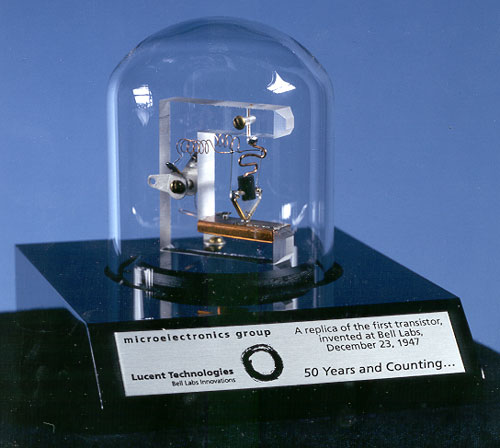
Since then, continuous improvement innovations objective is to shrink the size physical transistors.
As of this writing, transistors leverage single-atom-wide graphene gates component, that is just one carbon atom thick, measuring approximately (0.34) nanometers. Unit of measurement for transistors are in "Angstrom Width" as in 1 Angstrom (Å) = 0.1 nanometers (nm).
Even on consumer grade cpu's and phones, transistor in billions are the norm.
Observation:
The existence of the physical object, i.e. transistor, enables the downstream logical representations of the digital-binary construct.
What is the Age of Information?
The word "information" is the concept of formation of something in the mind. Continuous improvements in the digital age enables storing, processing and transmitting of data in bits. These externally available data when accessible and consumed by man through their senses, allows the man to mentally arrange and transform the data into useful information in the mind.
Historical Context
Mother of All Demos On December 9, 1968 GC, event known as the "Mother of All Demos (MOAD)", showcased for the first time, revolutionary concepts like the computer mouse, windows on screen, bit-mapped graphical user interface, hypertext and hyperlinking, video conferencing and collaborative real-time editing. Since this event, technologists have incrementally advanced to create better, faster, prettier, more connected and more secure variations of the concepts presented on that day.
Open Internet Standards On April 7, 1969 GC, the first RFC (Request for Comments) is shared, laying the ground work for open global standard network called the internet.
As of this writing, there 9906 RFC's in play. These proposed design patterns for global open network communications, has been adopted and with many becoming the defacto standard protocols used for consuming hyperlinks, video conferencing and collaborative real-time editing.
Open Software to Interface with Hardware and to Power Global Infrastructure September 17, 1991 GC, linux kernel is first shared and by December 1992, the kernel is release under General Public License allowing for free distribution, modification and commercial sales, ensuring the source code remains open, available and free to all.
As of this writing, linux dominates the infrastructure powering global networks, large-scale routing, clouds, data centers, web servers, super computers, phones and embedded devices. Estimated 90-96% of top web server, i.e. where "Information" are made available via url's and hyperlinks, are run on top of linux.
Observation:
Continuous creation and consumption of "information" are enabled by Information Technologies.
Age of Cloud & Delivery as a Service
September 28, 2011 GC, NIST (National Institute of Standards and Technology) publishes 800-145 "NIST Definition of the Cloud Computing". In 722 words, NIST succinctly provides the captured high level constraining boundary concept of the "Cloud" along with the 5 Essential Characteristics of the Cloud, 3 Service Delivery Models of the Cloud and 4 Deployment Models of the Cloud.
The 5 Essential Characteristics of ..
- On-demand self-service
- Broad network access
- Resource pooling
- Rapid elasticity
- Measured service
The 3 Service Delivery Models of ...
- IaaS (Infrastructure as a Service)
- PaaS (Platform as a Service)
- SaaS (Software as a Service)
provide the higher level logical envisioning of the how the services are provided and consumed "as a Service"
The 4 Deployment Models of
- Private Cloud
- Pubic Cloud
- Community Cloud
- Hybrid Cloud
NIST 800-145 standardizes the concepts though language
Anything significant cannot occur without Information Technology Solutions.
What is the Age of Good Governance?
Transparency and Good Governance